Mastering Sophisticated Uses At B2 level, you'll explore the sophisticated ways Past Perfect is used in literary narratives, formal writing, and nuanced communication. Understanding these will give your English a polished, professional quality. 1. Past Perfect Passive...
Rexroth Course Content

This is the hub where you can see all your course content, plus any other useful bits of grammar, articles, etc, that your teacher has decided can help you.
And don't forget to check out our large and growing collection of articles on current topics, always refreshed and updated, and set for your level of English. And of course, always with a quiz at the end!
Past Perfect – Development (B1)
Building on the Foundation You already know how to form Past Perfect and use it to show which action happened first. Now let's explore Past Perfect Continuous, more complex time sequences, and subtle distinctions in storytelling. Past Perfect Continuous An extension...
Past Continuous – Advanced (B2)
Mastering Sophisticated Uses At B2 level, you'll explore the subtle and sophisticated ways Past Continuous is used in literature, formal writing, and nuanced communication. Understanding these will give your English a more polished, native-like quality. 1. Past...
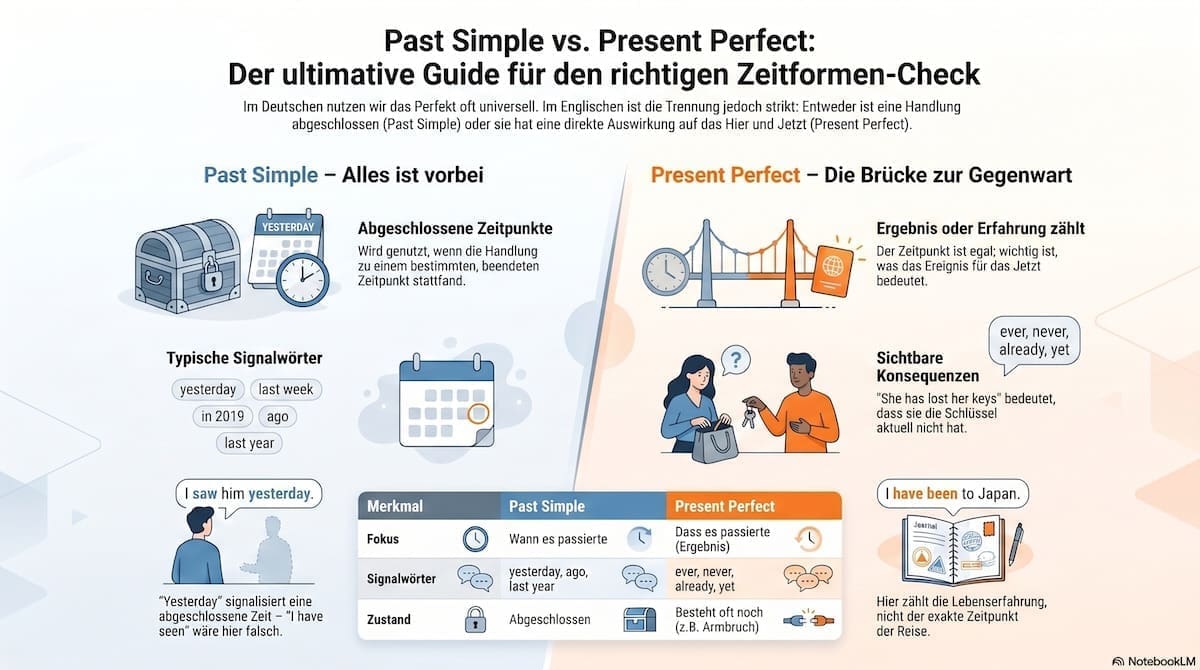
Present Perfect vs. Past Simple
Here is finally the ultimate explanation of the Present Perfect, after which we will always know exactly what it is and how to use it. 🙂 In German, we very often simply use the Perfekt: Ich habe gearbeitet. Ich habe ihn gesehen. Sie ist gegangen. In English, however,...
Conditionals (If-Clauses)
What Are Conditionals? Conditionals are sentences with "if" that express different types of situations: Facts and general truths (Zero Conditional) Real possibilities in the future (First Conditional) Unreal/imaginary situations in the present or future (Second...
Phrasal Verbs
What Are Phrasal Verbs? Phrasal verbs are combinations of a verb + particle (a preposition or adverb) that create a new meaning - often completely different from the original verb. Examples: look (verb) + after (particle) = look after (take care of) give (verb) + up...
Present Continuous Advanced (B2)
Mastering Sophisticated Uses At B2 level, you'll explore the subtle and sophisticated ways Present Continuous is used in professional, academic, and formal contexts. Understanding these nuances will make your English sound more natural and fluent across different...
Past Simple – Advanced (B2)
Mastering Sophisticated Uses At B2 level, you'll explore the subtle ways Past Simple is used in literary contexts, formal writing, journalism, and nuanced communication. Understanding these will elevate your English to a more sophisticated level. 1. Past Simple in...
Present Continuous Intermediate (B1)
Present Continuous - Intermediate (B1) Building on the Foundation You already know how to form Present Continuous and use it for actions happening now, temporary situations, and future plans. Now let's explore more sophisticated uses that will make your English sound...
Passive Voice Common Mistakes and Practice
⏭️ Already know the theory? Go straight to the quiz! 👈 Just arriving? Start at the beginning: Part 1: What Is Passive Voice & Why Use It | Part 2: How to Form the Passive Voice You've learned what passive voice is and how to form it. Now let's make sure it...
A2 & B1 General Grammar
No Results Found
The page you requested could not be found. Try refining your search, or use the navigation above to locate the post.
Useful Articles
Articles Pt. 2
Articles in English: Part 2 of 3 This is Part 2 of our 3-part guide to English articles. In this part, you'll learn how to use the. Haven’t done Part 1 yet? Start here first: Part 1: What Articles Are + A/An When you finish this page, continue with Part 3: Zero...
Articles Pt. 3
Articles in English: Part 3 of 3 This is Part 3 of our 3-part guide to English articles. In this part, you'll learn when to use no article, how to choose between a/an, the and zero article, and you'll practise everything. If you haven’t done the earlier parts yet,...
Sentence Order (Word Order)
Why Is Word Order Important? In English, word order is CRUCIAL because it determines meaning. Unlike some languages where word endings show the function of each word, English relies heavily on the position of words. Compare: The dog bit the man. (the dog did the...
Reported Speech (Indirect Speech)
What Is Reported Speech? Reported speech (also called indirect speech) is when we tell someone what another person said, without using their exact words. Direct Speech: "I am tired," she said. (exact words in quotation marks) Reported Speech: She said (that) she was...
Modal Auxiliaries (Modal Verbs)
What Are Modal Verbs? Modal verbs (also called modal auxiliaries) are special helping verbs that express: Ability: can, could, be able to Permission: can, may, could Obligation: must, have to, should Possibility: may, might, could Advice: should, ought to Necessity:...
Understanding Relative Clauses Pt. 3 – Advanced Use Cases
👈 Just arriving? Start at the beginning: Part 1: Who, Which & That | Part 2: Defining vs. Non-Defining & Omitting Pronouns ⏭️ Already know the theory? Go straight to the full quiz! You've mastered the core relative pronouns and the defining/non-defining...

0 Comments