Mastering Sophisticated Uses At B2 level, you'll explore the sophisticated ways Past Perfect is used in literary narratives, formal writing, and nuanced communication. Understanding these will give your English a polished, professional quality. 1. Past Perfect Passive...
JH Course Content

This is the hub where you can see all your course content, plus any other useful bits of grammar, articles, etc, that your teacher has decided can help you.
And don't forget to check out our large and growing collection of articles on current topics, always refreshed and updated, and set for your level of English. And of course, always with a quiz at the end!
Past Perfect – Development (B1)
Building on the Foundation You already know how to form Past Perfect and use it to show which action happened first. Now let's explore Past Perfect Continuous, more complex time sequences, and subtle distinctions in storytelling. Past Perfect Continuous An extension...
Past Continuous – Advanced (B2)
Mastering Sophisticated Uses At B2 level, you'll explore the subtle and sophisticated ways Past Continuous is used in literature, formal writing, and nuanced communication. Understanding these will give your English a more polished, native-like quality. 1. Past...
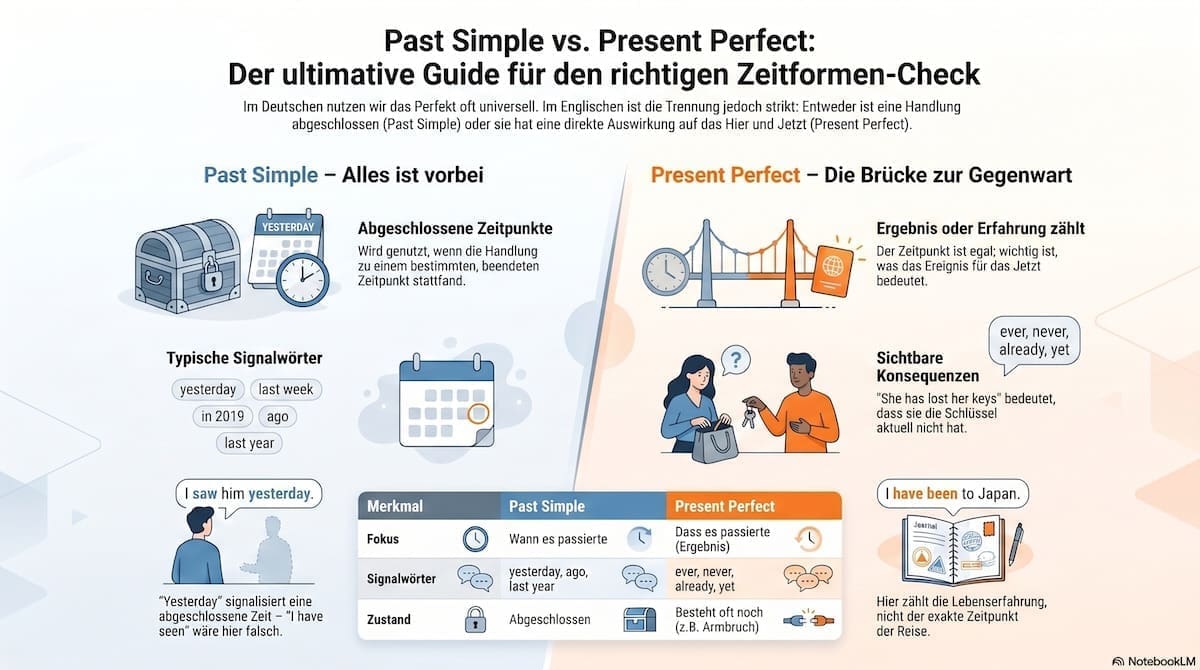
Present Perfect vs. Past Simple
Here is finally the ultimate explanation of the Present Perfect, after which we will always know exactly what it is and how to use it. 🙂 In German, we very often simply use the Perfekt: Ich habe gearbeitet. Ich habe ihn gesehen. Sie ist gegangen. In English, however,...
Conditionals (If-Clauses)
What Are Conditionals? Conditionals are sentences with "if" that express different types of situations: Facts and general truths (Zero Conditional) Real possibilities in the future (First Conditional) Unreal/imaginary situations in the present or future (Second...
Phrasal Verbs
What Are Phrasal Verbs? Phrasal verbs are combinations of a verb + particle (a preposition or adverb) that create a new meaning - often completely different from the original verb. Examples: look (verb) + after (particle) = look after (take care of) give (verb) + up...
Present Continuous Advanced (B2)
Mastering Sophisticated Uses At B2 level, you'll explore the subtle and sophisticated ways Present Continuous is used in professional, academic, and formal contexts. Understanding these nuances will make your English sound more natural and fluent across different...
Past Simple – Advanced (B2)
Mastering Sophisticated Uses At B2 level, you'll explore the subtle ways Past Simple is used in literary contexts, formal writing, journalism, and nuanced communication. Understanding these will elevate your English to a more sophisticated level. 1. Past Simple in...
Present Continuous Intermediate (B1)
Present Continuous - Intermediate (B1) Building on the Foundation You already know how to form Present Continuous and use it for actions happening now, temporary situations, and future plans. Now let's explore more sophisticated uses that will make your English sound...
Passive Voice Common Mistakes and Practice
⏭️ Already know the theory? Go straight to the quiz! 👈 Just arriving? Start at the beginning: Part 1: What Is Passive Voice & Why Use It | Part 2: How to Form the Passive Voice You've learned what passive voice is and how to form it. Now let's make sure it...
B2 & C1 General Grammar
Reflexive Pronouns (myself, yourself, etc.)
Reflexive Pronouns: Learn & Practice Reflexive Pronouns Master the art of using myself, yourself, and more What Are Reflexive Pronouns? Reflexive pronouns are special pronouns that refer back to the subject of a sentence. They end in "-self" (singular) or "-selves"...
Modals review (should, mustn’t, don’t have to, might)
Modal Verbs Review & Quiz Modal Verbs Review Master the nuances of should, mustn't, don't have to, and might Understanding Modal Verbs Should Meaning: Advice, recommendation, or what is considered right or appropriate Usage: Used to give suggestions or express what we...
First and Second Conditionals (If I have time, I’ll…)
First and Second Conditionals First and Second Conditionals Conditional sentences help us talk about possibilities, hypothetical situations, and their consequences. The first and second conditionals are two of the most commonly used patterns in English. First...
Used to (talk about past routines)
Used To - Past Routines Used To Talking About Past Routines and Habits What Does "Used To" Mean? We use used to to talk about things that were true in the past but are not true now. It's especially useful for describing: Past habits or routines that we no longer do...
Past Continuous (was doing)
Past Continuous Tense - Learning Module Past Continuous Tense Master the art of describing ongoing actions in the past What is the Past Continuous? The Past Continuous (also called Past Progressive) is used to describe actions that were in progress at a specific...
Present Perfect Continuous (have been doing)
Present Perfect Continuous - Learning Guide Present Perfect Continuous Master the tense that connects the past with the present What is the Present Perfect Continuous? The Present Perfect Continuous (also called Present Perfect Progressive) is used to describe actions...
Useful Articles (B2 & C1 Level)
No Results Found
The page you requested could not be found. Try refining your search, or use the navigation above to locate the post.

0 Comments