This post is also available in:
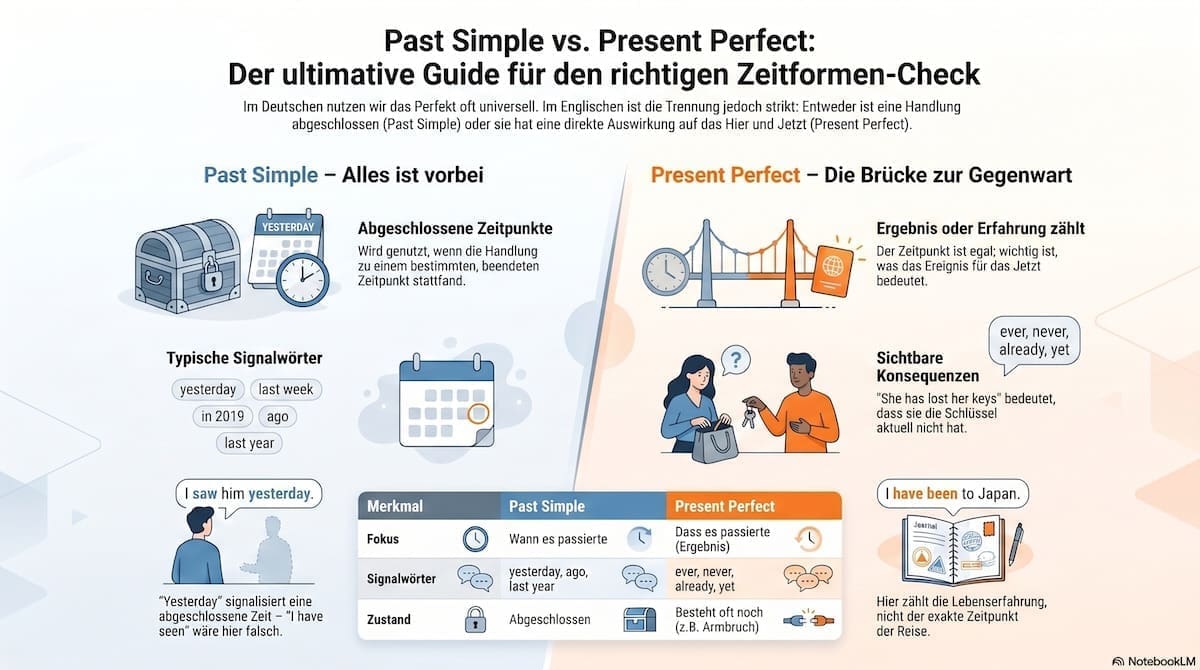
- English separates Past Simple (finished past actions) from Present Perfect (past actions connected to now), while German often uses the same form for both situations
- Use Past Simple when mentioning a specific completed time (yesterday, last week, in 2019) - never Present Perfect with these time words
- Use Present Perfect when the result or effect is still important now, or when talking about life experiences without mentioning when exactly they happened
- "She has gone to London" means she's still there, but "She went to London" just states the past action without saying if she's back or not
- Present Perfect focuses on the connection to the present moment, while Past Simple focuses only on what happened in the past
Here is finally the ultimate explanation of the Present Perfect, after which we will always know exactly what it is and how to use it. 🙂
In German, we very often simply use the Perfekt:
- Ich habe gearbeitet.
- Ich habe ihn gesehen.
- Sie ist gegangen.
In English, however, you have to distinguish very carefully between:
- Past Simple → completed past
- Present Perfect → past with a connection to the present
This is often difficult for native German speakers because German does not make this distinction as strongly.
The Basic Idea
1. Past Simple = completed past
Something simply happened and is completed.
Examples
- I saw him yesterday.
- She finished the report last night.
- We went to Berlin in 2022.
German
- Ich habe ihn gestern gesehen.
- Sie hat den Bericht gestern Abend fertig gemacht.
- Wir sind 2022 nach Berlin gefahren.
In German, you often use the Perfekt —
but English still needs the Past Simple here.
Most Important Rule:
When a finished time period is mentioned, English almost always uses Past Simple.
Typical Signal Words:
- yesterday
- last week
- in 2019
- two hours ago
Incorrect in English:
- ❌ I have seen him yesterday.
Why incorrect?
Because “yesterday” is a finished time period.
Correct:
- ✅ I saw him yesterday.
2. Present Perfect = past with reference to now
Here it is not primarily about when something happened.
Instead:
- the result is important right now
- the experience counts
- the situation affects the present
Example 1: Experience
Present Perfect
- I have been to Japan.
Meaning:
→ I was in Japan at some point in my life.
The exact time does not matter.
Past Simple
- I went to Japan in 2018.
Now the time is important.
Example 2: Result important now
Present Perfect
- She has lost her keys.
Meaning:
→ She does not have the keys right now.
The problem still exists.
Past Simple
- She lost her keys.
Meaning:
→ That happened at some point in the past.
Maybe she has found them again in the meantime.
Very Important Difference
She has gone to London.
→ She is in London.
→ She has not returned yet.
She went to London.
→ She traveled to London.
→ No information about whether she is back.
Another Extremely Important Difference
I have broken my arm.
→ My arm is broken right now.
The result still applies.
I broke my arm.
→ That happened at some point.
→ Maybe ten years ago.
Native German Speakers Often Make This Mistake:
German:
- Ich habe gestern gearbeitet.
Many translate:
- ❌ I have worked yesterday.
But English thinks:
“Yesterday = finished time period.”
Therefore:
- ✅ I worked yesterday.
Why Is This So Hard?
Because the German Perfekt has two functions:
- normal past
- connection to the present
English separates these functions much more strictly.
A Very Helpful Short Rule
Question 1:
Is the time period finished?
Then:
→ Past Simple
Examples:
- yesterday
- last year
- in 2020
- an hour ago
Question 2:
Is the connection to the present important?
Then:
→ Present Perfect
Examples:
- experience
- result visible right now
- problem still exists
- life events
- “ever”, “never”, “already”, “yet”
A Mini-Pair That Shows the Difference Perfectly
She has left.
→ She is gone.
→ She is not here right now.
She left.
→ She left at some point.
→ Focus is only on the action in the past.
Particularly Important:
In British English, the Present Perfect is used more frequently than in American English.
For example:
British:
- Have you eaten yet?
American often:
- Did you eat yet?
Both are understood —
but British English sticks more strictly to the rule.
Words from 13.5
Pecking order - ranking order
Cage - cage
Hamster - hamster
Guinea Pig - guinea pig
Gerbil - gerbil
Hedgehog - hedgehog
Eagle - eagle
Ladybird / Ladybug - ladybug
Patience - patience
Patient (adjective) - patient
Patient (noun) - patient
Degrees - degree
Shiver - shiver
At least - at least
I can't do jack - us slang - I can't do anything
Practice Quiz
Click here to take the interactive quiz
Hard Quiz
Click here to take the the quiz challenge!
This post is also available in:

